
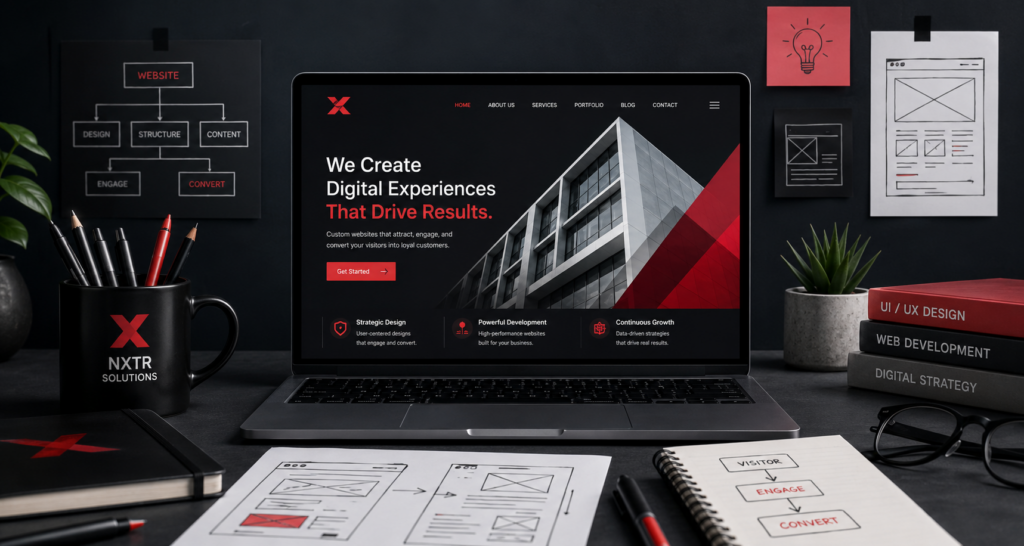
In today’s digital-first marketplace, your website is far more than an online brochure—it’s the foundation of your brand’s online presence and often the first interaction potential customers have with your business. A professionally designed website can establish credibility, engage visitors, and convert them into paying customers. On the other hand, a poorly designed website can drive prospects away within seconds.
A high-converting website isn’t built by chance. It combines strategic planning, exceptional user experience, compelling content, technical performance, and data-driven optimization. Every design choice should guide visitors toward a specific action, whether that’s requesting a quote, scheduling a consultation, making a purchase, or contacting your team.
At NXTR Solutions, we believe that successful websites balance creativity with functionality. Every page should serve a purpose, every element should support the user journey, and every interaction should move visitors closer to becoming loyal customers.
This guide explores the essential principles behind designing a business website that doesn’t just look impressive—it consistently delivers measurable business results.
What Is a High-Converting Business Website?
A high-converting website is designed with one primary objective: turning visitors into customers or qualified leads.
Conversions can include:
- Contact form submissions
- Quote requests
- Phone calls
- Newsletter signups
- Product purchases
- Appointment bookings
- Demo requests
- Live chat conversations
Instead of focusing solely on aesthetics, high-converting websites prioritize user behavior. Every design decision is based on helping users quickly find information and confidently take action.
Successful websites answer important questions immediately:
- What does this company do?
- Why should I trust them?
- What problem do they solve?
- Why are they different?
- What should I do next?
If your website answers these questions clearly, visitors are much more likely to convert.
Understand Your Target Audience Before Designing
Many businesses make the mistake of designing a website based on what they personally like instead of what their customers need.
Before choosing layouts, colors, or fonts, understand your audience.
Ask yourself:
- Who is your ideal customer?
- What problems are they trying to solve?
- What motivates their purchasing decisions?
- What questions do they ask before buying?
- What concerns prevent them from contacting you?
For example:
A manufacturing company may prioritize technical specifications.
A law firm may emphasize trust and credibility.
An eCommerce brand focuses on product presentation.
A technology company highlights innovation and expertise.
Understanding user intent allows every page to communicate more effectively.
Start with Clear Business Goals
Every successful website begins with measurable objectives.
Examples include:
- Increase qualified leads by 40%
- Generate 100 monthly quote requests
- Double online sales
- Increase consultation bookings
- Improve customer inquiries
- Build brand awareness
These goals influence:
- Page layouts
- Navigation
- Calls-to-action
- Landing pages
- Forms
- Content strategy
Without defined goals, even beautiful websites struggle to produce meaningful results.
Create a Strong First Impression
Research consistently shows that visitors form opinions about a website within seconds.
The homepage should instantly communicate:
- Who you are
- What you offer
- Who you help
- Why customers should choose you
Your hero section should include:
A Powerful Headline
Instead of:
Welcome to Our Website
Use something like:
Innovative Digital Solutions That Help Businesses Grow Faster
The headline should communicate value immediately.
A Supporting Description
Briefly explain your services.
Example:
“From custom web development and UI/UX design to AI-powered business solutions, NXTR Solutions helps organizations build digital experiences that drive measurable growth.”
A Primary Call-to-Action
Examples:
- Request a Free Consultation
- Get Started Today
- Schedule a Demo
- Talk to Our Experts
Avoid overwhelming users with too many competing buttons.
Keep Navigation Simple
Visitors should never struggle to find information.
A clear navigation menu reduces confusion and improves conversions.
Recommended structure:
- Home
- About
- Services
- Portfolio
- Industries
- Blog
- Contact
Avoid excessive dropdowns or unnecessary pages.
Simple navigation improves both user experience and SEO.
Design for Mobile First
More than half of website traffic now comes from smartphones and tablets.
A mobile-friendly website is no longer optional.
Mobile optimization should include:
- Responsive layouts
- Readable typography
- Large tap targets
- Fast loading pages
- Mobile-friendly forms
- Click-to-call buttons
- Easy navigation
Google also prioritizes mobile usability when ranking websites.
Improve Website Speed
Website speed directly impacts both SEO and conversions.
Users expect pages to load almost instantly.
A slow website leads to:
- Higher bounce rates
- Lower engagement
- Reduced trust
- Fewer leads
- Lower sales
Ways to improve performance include:
- Compress images
- Minify CSS and JavaScript
- Use browser caching
- Optimize fonts
- Reduce unnecessary plugins
- Implement lazy loading
- Use a reliable hosting provider
- Deliver assets through a CDN when appropriate
Fast websites create smoother user experiences and encourage visitors to stay longer.
Focus on User Experience (UX)
Excellent UX removes friction from the customer journey.
Ask yourself:
Can visitors quickly understand what your business offers?
Can they easily contact you?
Can they find pricing or service information?
Can they complete forms without frustration?
A user-friendly website includes:
- Logical page structure
- Clear visual hierarchy
- Consistent branding
- White space
- Readable fonts
- Intuitive buttons
- Easy navigation
Every click should feel natural.
Build Trust with Social Proof
Trust is one of the biggest factors influencing conversions.
Include credibility elements such as:
- Customer testimonials
- Client reviews
- Case studies
- Success stories
- Industry certifications
- Awards
- Years of experience
- Client logos
- Project statistics
For example:
- 500+ Successful Projects
- 98% Client Satisfaction
- Global Client Base
- Experienced Development Team
These signals reassure visitors that your business can deliver results.
Use Strong Calls-to-Action (CTAs)
Every important page should guide visitors toward the next step.
Effective CTAs are clear, action-oriented, and easy to find.
Examples include:
- Get a Free Quote
- Book Your Consultation
- Start Your Project
- Speak with an Expert
- Request a Proposal
Position CTAs strategically throughout your pages rather than only at the bottom.
Write Content That Solves Customer Problems
Website copy should focus on customer outcomes rather than simply listing features.
Instead of saying:
“Our developers use modern technologies.”
Explain the benefit:
“Our experienced developers build secure, scalable, and high-performance websites that help businesses attract more customers and increase conversions.”
People buy solutions—not technical jargon.
Every page should answer:
- What problem do we solve?
- How do we solve it?
- Why are we different?
- What happens next?
Prioritize SEO from the Beginning
Many businesses invest heavily in website design but overlook search engine optimization (SEO). A visually appealing website is only effective if people can find it. Incorporating SEO from the planning stage helps your website attract qualified traffic and generate long-term business growth.
Keyword Research Comes First
Start by identifying the keywords your potential customers use when searching for your products or services.
For example:
- Business website design
- Professional web development
- Custom website development
- Responsive website design
- UI/UX design services
- Digital transformation solutions
- Website redesign company
- Corporate web development
Focus on keywords that match user intent. Someone searching for “How to design a high-converting business website” is looking for guidance, while someone searching “Business website design agency“ is closer to hiring a service provider.
Optimize Every Page
Every page should include:
- One primary keyword
- Related secondary keywords
- Optimized title tag
- Meta description
- Proper heading hierarchy (H1, H2, H3)
- Image alt text
- Internal links
- External references when appropriate
- Descriptive URLs
For example:
Good URL
yourdomain.com/high-converting-business-website
Instead of:
yourdomain.com/page?id=2547
Simple URLs improve usability and SEO.
Create Landing Pages with One Goal
A common mistake is creating pages that try to accomplish too many objectives.
Instead, every landing page should focus on one primary conversion.
Examples include:
- Request a quote
- Book a consultation
- Download a guide
- Contact sales
- Start a project
Avoid cluttering landing pages with excessive navigation, unrelated promotions, or unnecessary content.
Everything should support one action.
Use Visual Hierarchy to Guide Visitors
Good design naturally directs attention.
Visual hierarchy determines what users notice first.
Important elements should stand out through:
- Larger headlines
- Strategic spacing
- Contrasting colors
- Clear buttons
- High-quality imagery
- Consistent typography
Visitors should immediately recognize:
- What the page is about
- Why it matters
- What they should do next
This creates a smoother customer journey and improves conversion rates.
Use Professional Branding Consistently
Strong branding builds trust and recognition.
Maintain consistency across:
- Logo placement
- Color palette
- Typography
- Icons
- Photography style
- Button design
- Illustrations
- Messaging tone
For NXTR Solutions, consistency reinforces your reputation as a modern technology partner. A cohesive visual identity communicates professionalism and helps visitors remember your brand.
Choose Colors That Encourage Action
Colors influence emotions and user behavior.
While every brand has its own visual identity, certain principles remain effective:
- Blue conveys trust and professionalism.
- Red creates urgency and attracts attention.
- Green often represents growth and success.
- Black communicates sophistication and authority.
- White improves readability and creates a clean appearance.
Use accent colors to highlight calls-to-action rather than applying them everywhere.
Invest in High-Quality Images
Visual content has a significant impact on first impressions.
Avoid:
- Generic stock photos
- Low-resolution graphics
- Pixelated banners
- Inconsistent image styles
Instead, use:
- Professional team photos
- Real office environments
- Product screenshots
- Project portfolios
- Custom illustrations
- Branded graphics
Authentic visuals help establish credibility and create a stronger connection with visitors.
Make Contact Information Easy to Find
One of the simplest ways to increase conversions is by making it effortless for visitors to contact you.
Include contact details in:
- Header
- Footer
- Contact page
- Service pages
- Call-to-action sections
Useful contact options include:
- Phone number
- Business email
- Contact form
- Office location
- Google Maps integration
- Social media links
- Live chat
Reducing friction increases the likelihood that visitors will reach out.
Keep Forms Short and Simple
Long forms often discourage users from completing them.
Only request information you genuinely need.
A high-converting contact form might include:
- Name
- Email address
- Phone number (optional if appropriate)
- Company name
- Project details
Avoid asking for unnecessary details during the first interaction. You can gather additional information later in the sales process.
Build Trust Through Transparency
Customers want confidence before making a decision.
Clearly communicate:
- Your process
- Expected timelines
- Services offered
- Pricing approach (if applicable)
- Support availability
- Frequently asked questions
Transparency reduces uncertainty and encourages potential clients to take the next step.
Showcase Your Portfolio
People prefer to see evidence of your expertise rather than simply read about it.
A portfolio should demonstrate:
- Real client projects
- Before-and-after transformations
- Website redesigns
- Industry-specific solutions
- Mobile responsiveness
- UI/UX improvements
- Business results
For each project, include:
- The client’s challenge
- Your solution
- Technologies used
- Measurable outcomes
This approach helps prospective clients visualize the value you can deliver.
Publish Case Studies
Case studies are among the most persuasive forms of content.
Instead of stating:
“We build great websites.”
Demonstrate it with real examples.
A strong case study typically includes:
The Challenge
What problem did the client face?
The Solution
What strategy and technologies were implemented?
The Results
Highlight measurable improvements, such as:
- Increased website traffic
- More qualified leads
- Improved conversion rates
- Faster loading speeds
- Better user engagement
Real-world success stories build trust and strengthen your credibility.
Add Testimonials Strategically
Testimonials are most effective when placed near calls-to-action.
Rather than grouping all reviews on one page, distribute them across:
- Homepage
- Service pages
- Landing pages
- Pricing pages
- Contact page
Include:
- Customer name
- Company
- Position (when permitted)
- Photo (if available)
Specific testimonials feel more authentic than anonymous quotes.
Incorporate Live Chat
Many visitors have questions before making a purchase or requesting a quote.
A live chat feature enables you to:
- Answer questions in real time
- Qualify leads
- Schedule consultations
- Reduce bounce rates
- Improve customer satisfaction
If live staffing isn’t feasible, an AI-powered chatbot can handle common inquiries and guide users to relevant resources.
Use Content to Educate Your Audience
Educational content positions your business as a trusted resource.
A regularly updated blog can cover topics such as:
- Website design trends
- SEO best practices
- User experience improvements
- Digital marketing strategies
- AI solutions for businesses
- Website security
- Conversion optimization
- Technology updates
High-quality content attracts organic traffic and builds authority over time.
Optimize Every Call-to-Action
Many websites use vague CTAs like:
- Learn More
- Click Here
- Submit
Replace them with action-oriented language that communicates value:
- Schedule Your Free Consultation
- Get Your Custom Website Quote
- Talk to Our Development Experts
- Start Your Digital Transformation
- Request a Website Audit
Visitors should immediately understand what happens after they click.
Use White Space Effectively
White space isn’t wasted space—it’s a design tool.
Proper spacing:
- Improves readability
- Highlights important elements
- Creates a modern appearance
- Reduces visual clutter
- Helps users focus
Minimalist layouts often convert better because they make information easier to process.
Design for Accessibility
An inclusive website serves a wider audience and demonstrates professionalism.
Accessibility best practices include:
- High color contrast
- Readable font sizes
- Keyboard navigation support
- Alternative text for images
- Clear form labels
- Descriptive link text
- Logical heading structure
Accessible websites provide a better experience for all users while supporting compliance with modern web standards.
Reduce Distractions
Every unnecessary element competes for your visitor’s attention.
Review each page and remove anything that doesn’t support the user’s goal, including:
- Auto-playing videos
- Excessive animations
- Intrusive pop-ups
- Cluttered sidebars
- Irrelevant banners
A focused design keeps users engaged and increases the likelihood of conversion.
Make Website Security a Priority
Trust is one of the biggest factors that influence online purchasing decisions. If visitors don’t feel their information is safe, they’re unlikely to contact your business or make a purchase.
A secure website protects both your business and your customers while strengthening your reputation.
Essential security measures include:
- SSL certificate (HTTPS)
- Secure hosting
- Regular software updates
- Daily website backups
- Firewall protection
- Malware scanning
- Two-factor authentication (2FA)
- Strong password policies
Displaying security badges and using HTTPS also reassures visitors that your website is trustworthy.
Improve Website Performance Continuously
Launching a website is only the beginning. High-performing business websites are continuously monitored and improved based on user behavior and performance metrics.
Key performance indicators (KPIs) include:
- Bounce rate
- Average session duration
- Conversion rate
- Form submissions
- Click-through rate (CTR)
- Exit pages
- Returning visitors
- Lead generation
By analyzing these metrics regularly, businesses can identify opportunities to improve the user experience and increase conversions.
Use Analytics to Understand Your Visitors
Without data, you’re making decisions based on assumptions.
Tools like Google Analytics and Google Search Console provide valuable insights into how visitors interact with your website.
Track metrics such as:
- Most visited pages
- Traffic sources
- Device usage
- Geographic locations
- User journeys
- Top-performing keywords
- Conversion paths
For example, if many users leave a service page without contacting you, it may indicate unclear messaging or a weak call-to-action.
At NXTR Solutions, we recommend making data-driven decisions to continuously optimize website performance.
A/B Test Important Elements
Even small design changes can significantly impact conversion rates.
A/B testing involves creating two versions of a webpage and comparing their performance.
Elements worth testing include:
- Headlines
- CTA button colors
- CTA button text
- Hero images
- Contact forms
- Page layouts
- Pricing displays
- Testimonials
- Navigation menus
Testing removes guesswork and helps identify what resonates best with your audience.
Leverage Artificial Intelligence
Artificial Intelligence (AI) is transforming the way businesses interact with website visitors.
Modern AI-powered features include:
- Intelligent chatbots
- Personalized content recommendations
- Predictive search
- Automated lead qualification
- Product recommendations
- Customer support automation
For example, an AI chatbot can answer common questions 24/7, schedule appointments, and collect lead information—even outside business hours.
By integrating AI strategically, businesses can improve customer satisfaction while increasing operational efficiency.
Personalize the User Experience
Personalization creates more relevant experiences for visitors.
Examples include:
- Displaying industry-specific content
- Showing location-based information
- Recommending relevant services
- Remembering returning visitors
- Customizing calls-to-action
A personalized experience helps visitors feel understood, making them more likely to engage with your business.
Optimize for Local Search
If your business serves a specific city or region, local SEO should be part of your website strategy.
Best practices include:
- Creating a Google Business Profile
- Adding your business address
- Embedding Google Maps
- Using location-specific keywords
- Displaying local testimonials
- Publishing local content
These tactics help your website appear in local search results, attracting nearby customers who are ready to take action.
Create Content That Builds Authority
Publishing valuable content positions your business as an industry expert.
Consider creating:
- How-to guides
- Industry insights
- FAQs
- Case studies
- Whitepapers
- Video tutorials
- Infographics
- Success stories
Educational content not only attracts organic traffic but also builds trust with potential customers.
Make Every Page Conversion-Focused
Every page should answer one key question:
“What action should the visitor take next?”
Whether it’s:
- Contact us
- Request a proposal
- Book a consultation
- Download a guide
- Subscribe to a newsletter
Make the next step clear and easy.
Avoid leaving visitors wondering what to do next.
Optimize Your Homepage
Your homepage should serve as a gateway to the rest of your website.
Include:
- Clear value proposition
- Overview of your services
- Customer testimonials
- Featured projects
- Trust indicators
- Call-to-action
- Contact information
Avoid overwhelming visitors with excessive text. Use concise messaging supported by visuals and strategically placed CTAs.
Design High-Converting Service Pages
Each service page should answer:
- What is the service?
- Who is it for?
- What problems does it solve?
- How does the process work?
- Why choose your company?
- How can visitors get started?
Structure your service pages with clear headings, engaging visuals, and compelling CTAs to guide users toward contacting your team.
Keep Your Website Updated
An outdated website can create a negative impression.
Regular updates should include:
- Fresh content
- New blog posts
- Updated portfolio
- Latest testimonials
- Security patches
- Software updates
- Team information
- Industry news
A well-maintained website demonstrates that your business is active and reliable.
Common Website Design Mistakes to Avoid
Even experienced businesses can make mistakes that reduce conversions.
Avoid these common issues:
Slow Loading Pages
Users expect fast performance. Delays often lead to higher bounce rates.
Cluttered Design
Too many elements compete for attention and confuse visitors.
Weak Headlines
Generic headlines fail to communicate value.
Poor Mobile Experience
A website that doesn’t function well on smartphones loses potential customers.
Complicated Navigation
Visitors should reach important information within a few clicks.
Low-Quality Images
Professional visuals enhance credibility.
Missing Calls-to-Action
Never assume visitors know what to do next.
Long Contact Forms
Only ask for essential information.
Inconsistent Branding
A unified visual identity builds recognition and trust.
Ignoring SEO
Even the best-designed website won’t generate results if it can’t be found online.
Future Trends in Business Website Design
Web design continues to evolve rapidly.
Businesses should prepare for trends such as:
- AI-powered personalization
- Voice search optimization
- Interactive user experiences
- Dark mode support
- Motion UI
- Accessibility-first design
- Headless CMS architecture
- Progressive Web Apps (PWAs)
- Faster Core Web Vitals performance
- Privacy-focused user experiences
Staying ahead of these trends helps businesses remain competitive in an increasingly digital marketplace.
Why Choose NXTR Solutions?
Designing a high-converting website requires more than attractive visuals. It demands strategic planning, technical expertise, user-centered design, and continuous optimization.
At NXTR Solutions, we combine innovative design with cutting-edge technology to create websites that support real business growth.
Our expertise includes:
- Custom Website Design
- Responsive Web Development
- UI/UX Design
- E-commerce Solutions
- AI-Powered Business Solutions
- Custom Software Development
- Website Maintenance & Support
- Digital Transformation Services
Every project is tailored to your unique goals, ensuring your website becomes a powerful tool for attracting visitors, generating leads, and driving long-term success.
Final Thoughts
A high-converting business website is one of the most valuable investments any company can make. It’s not just a digital storefront—it’s a sales representative, marketing platform, customer support channel, and brand ambassador working around the clock.
By focusing on user experience, performance, SEO, compelling content, strong calls-to-action, and ongoing optimization, businesses can create websites that consistently turn visitors into loyal customers.
Rather than treating your website as a one-time project, view it as an evolving business asset that grows alongside your company. Regular improvements, informed by user feedback and analytics, ensure your website continues delivering measurable results.
Whether you’re launching a new website or redesigning an existing one, investing in a strategic, conversion-focused approach will help your business stand out in a competitive digital landscape.
Frequently Asked Questions (FAQs)
1. What makes a business website high-converting?
A high-converting website combines clear messaging, intuitive navigation, fast loading speeds, mobile responsiveness, trust-building elements, and persuasive calls-to-action that encourage visitors to take the next step.
2. Why is mobile-friendly design important?
With most users browsing on smartphones and tablets, responsive design ensures a seamless experience across all devices, improving both user satisfaction and search engine rankings.
3. How often should I update my business website?
Review your website regularly and update content, portfolio items, testimonials, software, and security features at least every few months to keep it fresh and effective.
4. Does SEO affect website conversions?
Yes. SEO attracts qualified visitors who are actively searching for your services. When combined with an optimized user experience, it significantly increases the likelihood of conversions.
5. How can NXTR Solutions help my business?
NXTR Solutions specializes in designing and developing high-performance websites tailored to your business goals. From UI/UX design and custom development to AI integration and ongoing support, our team helps businesses build digital experiences that drive measurable growth.